Showing posts with label Luang Prabang. Show all posts

Friday, 12 April 2013

Eavesdropping by the Mekong

The Mekong - 4,300 km from its starting point on the Tibetan Plateau to the Mekong Delta in Vietnam, where it spills out into the South China Sea. It's a river of rapids and big changes in water levels making navigation impossible in places and difficult elsewhere. Add to that dam building for hydro electric power and there is the potential for a water war among the countries of the Mekong. Despite the difficulties, the Mekong is an important trade route between China and the countries to the south. Passenger boats ply short stretches of it and we took what's called a "slowboat" for two days upriver from Luang Prabang in Laos to Huay Xai, a town in northern Laos which serves as a border crossing into Thailand just across the river.

There is a related story (of sorts) below the pictures - scroll down.

The Mekong at Pak Beng, the overnight stop on the two day slowboat ride. The haze is caused by smoke from deliberately lit fires throughout the region.
With Sam Brockie in Luang Prabang - a chance meeting
as he pursues his own travels in SE Asia.
Plenty of room on the roof for our
tandem - the Beast of Bridgwater.


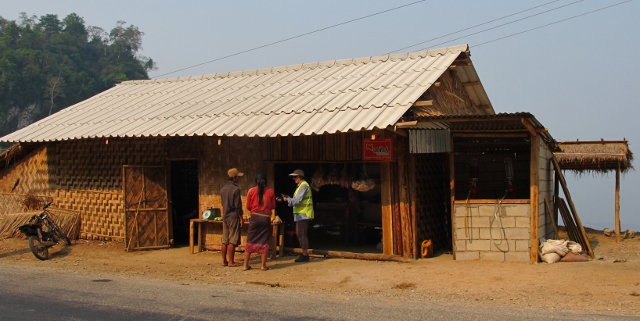
Our ferry made occasional stops along
the way to drop off or pick up
passengers at prearranged spots. This
was one of them.

Anyone for a swim? 


A couple of bamboo canes and
suddenly there's a place to secure
the boat.


Slash and burn agriculture - deliberately
lit fires fill the air with smoke and cinders.
The skipper's wife and deckhand.


Backpackers clutching their Beerlao come ashore at
Pak Beng, where the boat stops for the night. 
Nothing prissy here. You wanna
bring your motorscooter along?
Sure, provided you are prepared
to pay.


Two 10-hour days and not a lot to do except take in the
views - we found it a fascinating way to get a glimpse
of small communities which still have no road access.


The fast way along the river .  The
speedboats have a reputation for
being dangerous - perhaps not
surprising given the navigational
hazards that lie in their way and that,
in this case, only the driver is wearing
a helmet.


Eavesdropping by the Mekong

On the pontoon floating in the Mekong stood a man with a big belly. It hung out over his trousers and over both hung a loose, long sleeved shirt. Aged about 60, he looked a man at ease, comfortable in his surroundings and unlike many of the backpackers who scuttled about trying to ensure they caught the right boat - upriver or downriver depending on their destination.
Somewhere out there the sun is about to set but it's
impossible to see it through the smoke haze.
The man was taking photos of the pontoon with an expensive looking camera - the pontoon seemed a strange subject given the dramatic photo opportunities that abounded elsewhere - the post-apocalyptic scenes of smoke hanging low over the valley and the quaint slowboats tied up on the river’s edge.
I was intrigued - who was this man who stood out from everyone else and what was he doing here? Eventually he fell into conversation with a backpacking couple and from my vantage point perched on a rock nearby a picture began to emerge. The following are notes jotted down afterwards, they are certainly not verbatim and are only part of what he said, for he was a great talker.

Notes of Overhead Conversation - Pak Beng, Monday 8 April 2013

Hydro graphic surveyor runs a company here in Laos. Has seven teams surveying the Mekong. Most of their work is for the Government of Lao PDR (People’s Democratic Republic), compiling reports on river levels. The Government is particularly concerned about the impact dam building is having on river flows etc.
Recently China has completed three hydro power stations on its side of the border and already the impact is being felt. In 2010, when the dams were under construction, the Mekong fell to its lowest recorded level for the month of March because the Chinese were storing water in the headwaters of the Mekong behind temporary cofferdams. Ferry services on this stretch of the river could not operate. Now the dams are finished and generating power and right now (early April 2013) the Mekong is a metre above its usual level for this time of the year because the Chinese are spilling water. And the months ahead will be interesting, because this season has seen particularly heavy snowfalls in the upper (Tibet) reaches. When that snow melts, there will be more water than usual but how will the Chinese handle it. Scathing about China – “they don’t care about their neighbours”.

On China and Foreign Investment

Laos is only one of two countries in SE Asia that gives foreign investors unfettered access so they can come in and do what they like. The Chinese are investing heavily. In Vientiane, for example, they have built industrial complexes around the city and are gearing up for manufacture. “Who do you think they are doing it for? The people of Laos? Of course not, they are looking after themselves.” Part of it has to do with China’s one child policy. Families can settle here and have more children and eventually each child can end up running part of a business empire.

On Teak Trees

Slash and burn agriculture
“Those are teak trees over there,” says the man and my eyes swivel in the direction he’s pointing. He’s seen me turn and now he knows I’m listening to every word. But I suspect he enjoys having an audience. The backpacking couple have drifted away and now a quietly spoken man is asking the occasional question. It’s hard for me to hear him.
The teak trees look as though they are dying, but they are deciduous. Explains how teak  grows in Burma, across Thailand and into Laos but the variety here has cross pollinated with other species and the grain has a white streak through it. “Here in Laos they try to market it as special, but to western eyes it just doesn’t look right.” Some of the trees are lost thanks to slash and burn agriculture.The smoky haze is from the fires – especially the rice stubble being burnt across the region at this time of the year.

On Bodies in the Mekong

His surveyors find quite a few bodies – people caught in the river. “More bodies than we do dead buffalo”. Found five recently. And they found two with no heads. One was way south at Savannakhet (1,200 km away). Probably engaged in drug dealing – Golden Triangle not far from here. Decapitated and disposed of in the Mekong.

On Minerals and Natural Resources

People seen panning on the river’s edge would have been searching for gold and (?). Laos has big deposits of bauxite (the raw ingredient for aluminium production) including world’s biggest single deposit, plus silver and to a lesser extent gold. But gold “very fine” and needs chemical processing to extract it. Environmental concerns. And there are problems getting to the bauxite. In Australia, which has huge deposits, the bauxite lies under 3-4 metres of topsoil. It can be mined by scraping away the topsoil, removing the bauxite and then pushing the topsoil back into place and planting trees over the lot. In Laos there is no topsoil, the bauxite lies on the surface. Nothing grows on it, but once it’s mined there’s a problem – how do you fill in the holes left behind? The Laos Government is showing caution. While there are plenty of companies prepared to mine, the Government wants to know how the impact can be minimised. At the moment, the only bauxite deposits where anything grows is in the craters left behind by bombs during the Vietnam War era. The craters collect water, and eventually something grows.
The sun emerges and casts a glow on the waters of the Mekong - a
river that is an important trade route between China and its southern
neighbours, but what of its future? As dam building progresses will
it become a series of slowflowing and lifeless lakes?

On Living in Laos

Has lived in Laos 20 years and wouldn’t live anywhere else. Has a Laos wife and all his business interests are here. “People ask, ‘can you eat the food?’” (Puts both hands on his stomach) “Of course, I can. Look at me.”
He moves off to board his slowboat. For me, it’s time for breakfast and to reflect on everything he’s said.

Wednesday, 3 April 2013

Le Tour de Laos

TANDOIDS
Current Location: Luang Prabang, Laos.
Total Distance Cycled: 9,717 km.
Flat Tyres in SE Asia: four.
Worst Coffee:  Mama Pap Guesthouse, Tat Lo, Bolaven Plateau, Laos.
Time on the Road: One year since we left work.

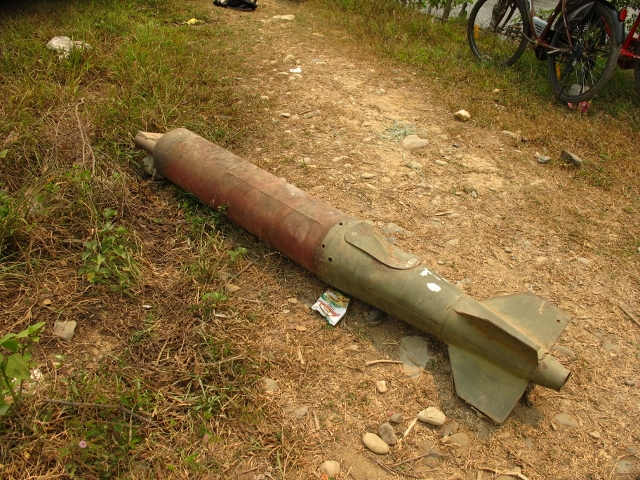
War junk left over from the U.S.
bombing of Laos (Vang Vieng))
It has to be a stretch of the imagination to compare the Tour de France with a bike ride in Laos but let’s give it a go.
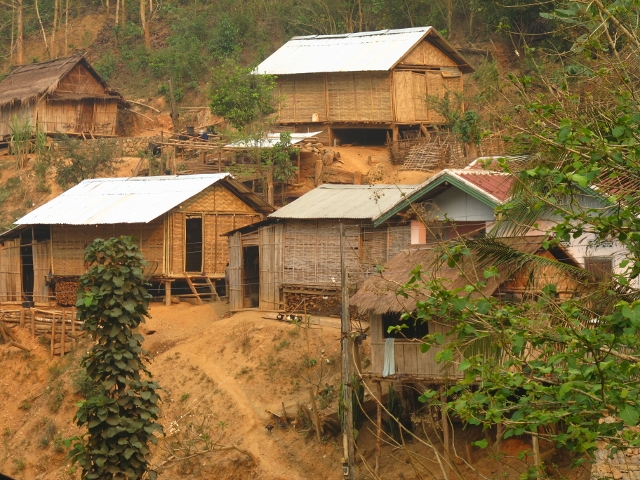
Among touring cyclists in South East Asia, the ride between the Laos capital, Vientiane, and the UNESCO world heritage town of Luang Prabang is about as good as it gets. There are strange limestone karsts and mountain vistas on which to feast the eyes and stiff climbs and frightening descents to provide a physical challenge. There are colourful villages - not the quaint, perfectly manicured ones of France but simple homes inhabited by hill tribes who cling to a way of life that hasn’t changed much over the past four decades. Sure they may have electricity and fresh water (the latter thanks to World Vision Australia), but the thatched roofs of many homes have not all been replaced with corrugated iron.
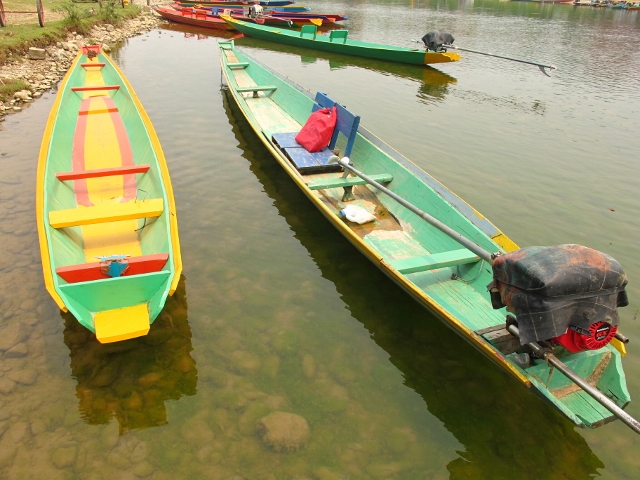
River boats, Vang Vieng
The ride is much shorter than the real Tour - just over 400 km, but for us in our 60s on a tandem it provided enough of a challenge to remind us of the pleasures and pain that come from real cycling - not the lowland, flat stuff we have experienced through much of the rest of SE Asia so far.
And unlike the real Tour, there are no rules - just a few suggestions.
Le Tour de Laos can be ridden either way - north or south, but it’s easiest cycling from Vientiane northwards so that two big climbs are avoided on the same day. Competitors are free to start whenever they like but may care to avoid the rainy season. We cycled at the end of March and while it was hot, the biggest disappointment was the constant haze from slash-and-burn agriculture.
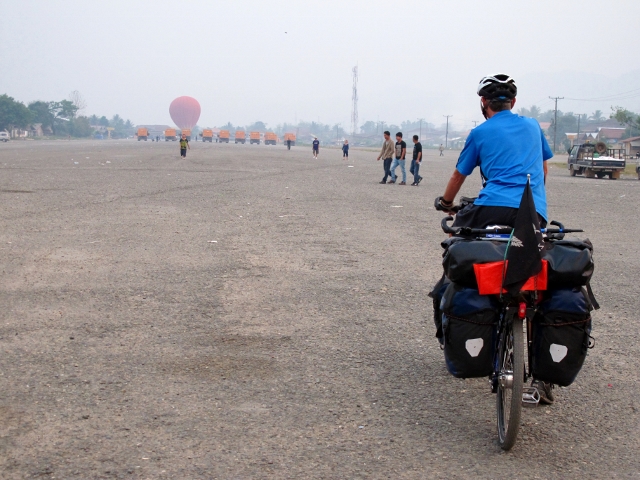
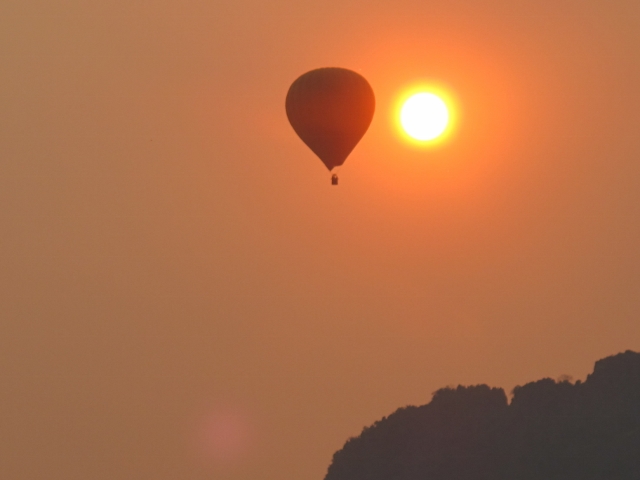
This old Lima air strip outside Vang Vieng was used by the
US during its Secret War. Now it's used to launch hot air
balloons.
To help get in the spirit of the real Tour, competitors heading out of Vientiane are urged to begin by riding along Th Lane Xang, a wide boulevard sometimes referred to as the Champs Elysees. Go past Patuxai, the concrete monstrosity with a vague resemblance to the Arc de Triomphe, and riders should be mentally adjusted to the Laos version of the French ride.
 If beginning in Luang Prabang, at least have a baguette and a cup of rich, strong Laos coffee before setting out.
Unlike the real Tour, no-one cares about performance enhancing drugs or alcohol, so plan your Laos ride safe in the knowledge that at the end of each day you will be able to rehydrate with lashings of Beerlao.
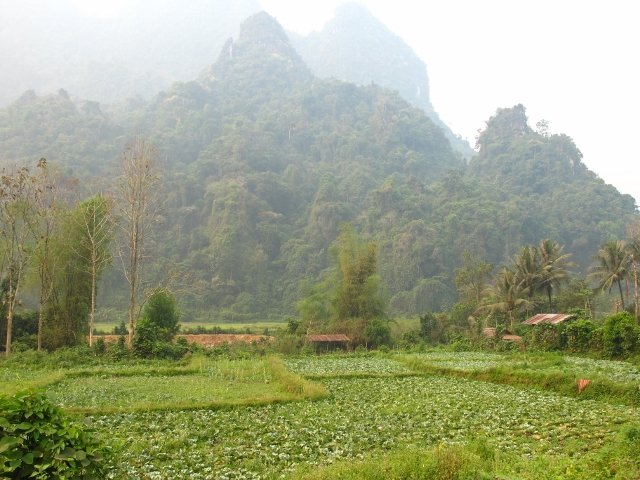
Cabbage patch, on the road
 north of Vang Vieng.
So, to the ride itself - March 2013
Stage 1: Vientiane to Hinheup on Highway 13 (92 km)
It took us more than an hour and 20 km to clear the northern outskirts of Vientiane, but suddenly we were in rolling countryside with only road works to contend with and one longish climb towards the end of the day. Hinheup lies on the Nam Lik River and in the dry season it’s worth riding down to the bridge to watch the locals floating downstream on inflated car tubes, some of them holding umbrellas to shade themselves from the sun. There are two guesthouses here although there wasn’t much sign of life at one of them.
Stage 2: Hinheup to Vang Vieng (65 Km)
Back on Highway 13, the day begins with rolling countryside until the northern end of the Nam Ngum Reservoir, a good place for a break and something to eat. An easy 20 km ride through more limestone karsts brings you into Vang Vieng.
Hot air ballooning at Vang Vieng.
Stage 3: Vang Vieng, rest day/s
We took the opportunity to relax in this town which until recently was a magnet for young backpackers who spent their time drunk, drugged and drowning themselves tubing in the Nam Song River. In the last year, the Government has stepped in, ripping out the floating bars and ordering an end to the most dangerous behaviour. Now Vang Vieng is much more subdued, and its visitors are taking part in safer pursuits such as kayaking, rock climbing and tubing without ‘substances’ (well, maybe just a can of Beerlao).
Stage 4: Vang Vieng to Kasi (66 km)
The first real test came today, but before we got to it a squeaking noise from our tandem grew steadily worse. We tried tightening the couplings that enable the frame to be taken apart, but it made no difference.
Kids on the road to Kasi.
In true Le Tour style, the spectators became a problem. As well as the usual cries of “sabaidee”, scores of young schoolboys wanted to “high five” Judy as we passed by. Some of them struck her hand so forcibly her arm became sore and we started to avoid these young fans. Other children ran alongside as we slowly climbed and some of them pushed from behind - trying to help but giving us the wobbles.
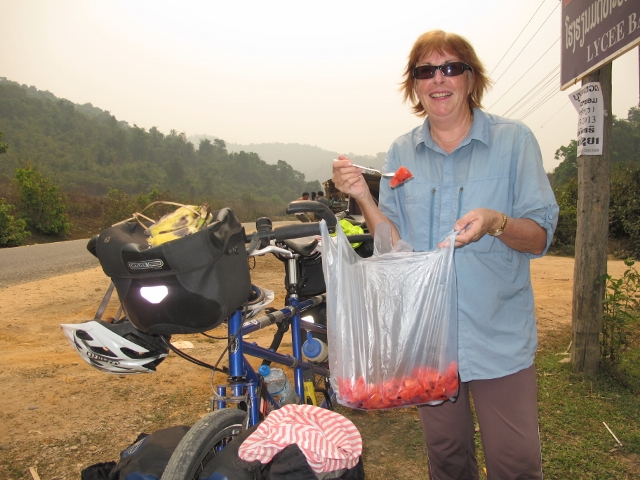
Watermelon stop - all ready to eat
out of a plastic bag.
About half way through the day’s ride we struck a stiff climb which went on for several kilometres. We stopped to drink from our water bottles a couple of times, but managed to cycle all the way up.
Our guesthouse at Kasi that evening sported a concrete table with an inset draughts table and draughtsmen made of bottle tops for one player and pebbles for the other. We sat in the dusk and had a game as we drank our Beerlao.

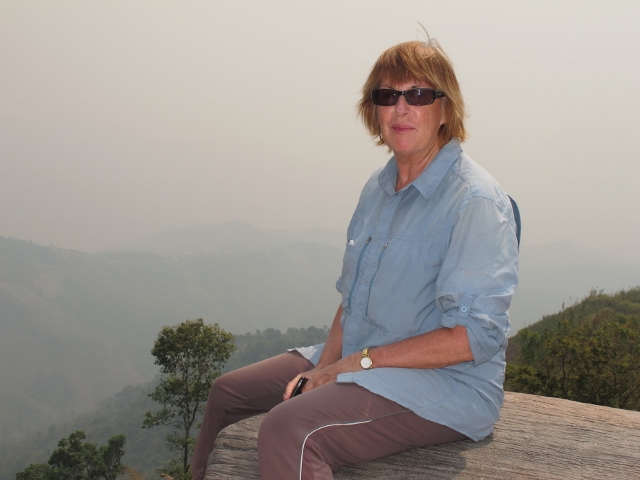
Judy at a scenic spot a few kilometres south of Phou Khoun.
Pity about the haze from slash-and-burn agriculture which
has obscured most of the view.

Stage 5 Kasi to Phou Khoun (45 km)
45 km may not be far, but there was lots of climbing and we were happy to take our time and enjoy the scenery. The highest point was at 1,388 m. Early on we traced the tandem’s squeak to two bolts used to adjust the tension of the front chain. By easing each bolt a quarter of a turn, the sound disappeared.
We passed through more Hmong villages and were overtaken by Michael, a young Swiss rider who chatted with us until we could no longer keep up. Later we stopped at a  roadside restaurant that would have had spectacular views if it wasn’t for the haze. We were joined by another cyclist whom we dubbed “The Monkey Man” and sported tight lycra bib overalls. Within a few minutes he had given us his life story – ex military policeman, martial arts expert, lived in Thailand 10 years, enjoyed the company of the hill country people (the women, he says, dance all night while the men sleep). He is like an Energizer battery and we are exhausted just listening to him. Fortunately, the climbing for the day is over and we have a gentle cruise over the last few kilometres into Phou Khoun.

Stage 5, Phou Khoun to Kiukacham (50 km)
Within a couple of kilometres of setting out, the winding road plunges downhill and we know we are going much too fast for safety. One of the disadvantages of tandems is that the extra weight of two people plus their luggage can cause the wheel rims to overheat from the friction caused by the brakes. The worst case scenario is a burst inner tube while travelling at speed. 
We checked the brakes and sure enough, the rims were too hot to touch for more than a split second. We walked the bike downhill until we were satisfied things had cooled down enough for safety, then climbed back on – repeating the process till we reached the bottom. Despite our efforts, the front tyre goes and we examine the tube - there is a tiny hole but no sign of a sharp object that could have punctured it. We make a roadside repair and carry on. 
The uppsy downsy riding continues as we climb back up to 1,400m and find a guesthouse with a surprisingly good restaurant at Kiukacham.
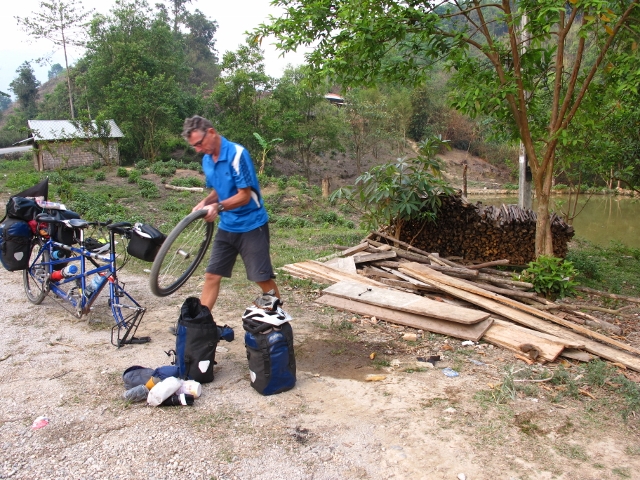
The first of two flat tyres in two days - as the rims
heat up from braking hard and the tubes deflate.

Stage 6 Kiukacham to Xiang Ngeun, (55 Km)
We have hardly set off the next morning before we are losing height again - more than 1,000 m in 20 km - and resume worrying about the brakes.
We make it safely to the bottom and stop at a bridge over the Nam Ming River to take photos before embarking on a 15 km climb up to more than 1,000 m altitude. On the way, we pass three women dangling what look like live rats by their tails. They are trying to sell them to passing motorists. Straddling the bike, it’s hard to get close enough to see if they’re rats or some other kind of rodent, and the language barrier makes it too difficult to ask.
At the top of the climb we stop in a small village for cold drinks at the only stall. It’s tiny and inside the owner is sitting on the floor playing with his baby son. He passes us two bright yellow Beerlao crates and insists we sit on them in the shade of his stall. The seats are just a small thing, but the hospitality doesn’t go unnoticed by us.
It was time for the second big descent of the day, and we set off cautiously. We alternated the use of the brakes  - first the back one, then rest it and use the front one - in the best tandem riding style.
Drink stop.
We were almost at the bottom and could see the road levelling out but our nerve failed us. We decided to pull over to walk the last few metres but as we slowed we could feel that unmistakable wobble that means a flat tyre.
We limped into the town of Xiang Ngeun and under the shade of a tree replaced the inner tube. Again, there was a tiny hole but no sign of what had caused the puncture.We gathered a small audience, one of whom was fascinated at what came out of a pannier – plastic cups, a jar of creamer, wet weather leggings and finally the tool kit. Judy took command of someone’s outside table so we could work clear of the dust and dirt.
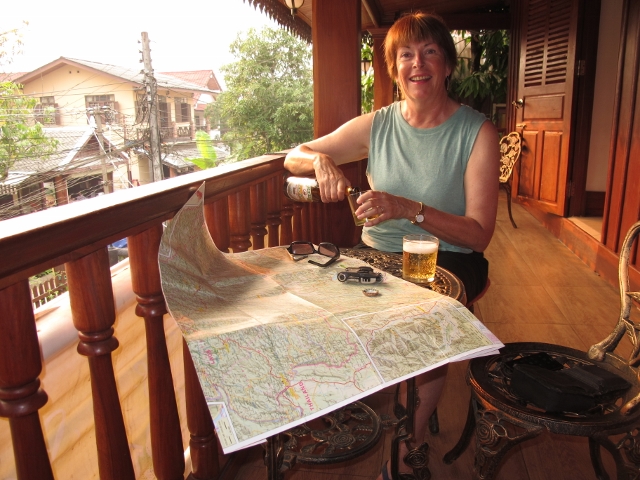
Judy celebrates our arrival in Luang Prabang with a beer
and a haircut.
Accommodation that night was definitely not up to the standard riders would expect on Le Tour but we didn’t care - we were in one piece and we knew there were no downhills to worry about the next day.
Stage 7 Xiang Ngeun to Luang Prabang (25 km)
With just a short, easy ride to Luang Prabang we enjoyed the luxury of a sleep-in until our alarm went off at 7 am. A cup of tea, some coconut snacks and we were back on the road. There was just one hill about halfway to Luang Prabang, otherwise it was an easy ride and we are there by mid-morning. We celebrated the end of Le Tour de Laos with egg-filled baguettes and coffee and went off to treat ourselves to a better-than-usual guesthouse.
Village on the Nam Ming River, northern Laos
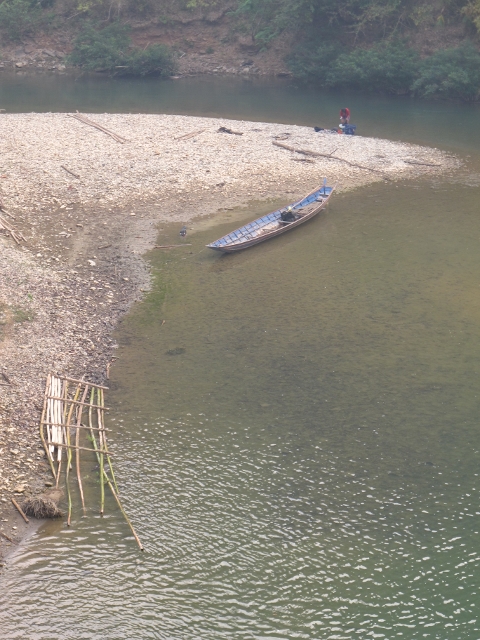
Nam Ming River